Karen Dolmanisth’s GATHERED GROUND: RITUAL, COMMUNITY AND EARTH brings together the accumulated knowledge of more than four decades of interdisciplinary artistic practice. Working across drawing, painting, photography, video, sculpture, installation, textiles, found and gathered materials, performance, and hand-built ceramics, Dolmanisth approaches these diverse media as interconnected languages through which to explore embodiment, memory, materiality, place, lineage, ecological relationship, and the human search for meaning.
Her practice begins with an embodied form of attention. Dolmanisth works from the inside outward, bringing together perception, sensation, movement, breath, intuition, memory, intellect, scholarship, and material knowledge. Formal discipline and conceptual intention remain essential, yet the work is not entirely predetermined. Materials are allowed to respond and participate. Gravity, tension, weight, fragility, light, air, repetition, duration, chance, and the particular conditions of a place become collaborators in an unfolding process. What emerges occupies a space between conscious intention and discovery, between the known and the unknown.
This methodology is rooted in an expansive understanding of art history. Dolmanisth’s practice reaches back toward some of humanity’s earliest forms of visual and material expression: mark-making, pattern, textile production, vessels, adornment, gathering, earth works, ceremonial objects, and the transformation of ordinary materials into carriers of memory and meaning. In prehistoric and ancient cultures, making was not yet divided into the categories of fine art, craft, design, domestic labor, and ritual that would develop much later. Material production was deeply interwoven with survival, community, cosmology, identity, seasonal cycles, and relationship to place.
Dolmanisth is particularly attentive to the histories of knowledge that have been diminished or made invisible within later patriarchal, institutional, economic, and religious structures. The work of spinning, weaving, sewing, mending, clothing, basketry, pottery, gardening, food cultivation, caregiving, and ceremonial making has frequently been relegated to the category of “craft,” despite the intellectual, technical, social, and cultural knowledge embodied within these practices. Her engagement with feminist art history recognizes the profound importance of the twentieth-century artists who challenged these hierarchies and expanded the definition of artistic practice to include the body, domestic labor, textiles, ritual, maintenance, lived experience, collaboration, and the everyday.
Dolmanisth carries this history forward without attempting to reconstruct an imagined past. Instead, she asks what forms of knowledge continue to live within the gestures and materials passed from one generation to another. Thread becomes one of the most resonant materials within this inquiry. As one of humanity’s oldest technologies, thread connects the practical and the symbolic: line, drawing, binding, weaving, clothing, shelter, continuity, repair, memory, lineage, and time. A single strand can become a structure, a pathway, a boundary, a web, or a drawing in space.
This understanding is also carried through Dolmanisth’s own maternal lineage. Sewing, knitting, crocheting, mending, clothing-making, gardening, and other forms of care passed through generations of women have informed her understanding of the hand as a site of knowledge. Such work was not simply decorative or domestic. It was an embodied intelligence through which women created, repaired, sustained, protected, clothed, nurtured, and remembered. In Dolmanisth’s practice, these inherited gestures become transformed into contemporary visual and spatial language.
Her relationship to the natural world is equally fundamental. Dolmanisth’s sustained engagement with the woods, river, shoreline, changing seasons, weather, plants, shells, stones, water, and other gathered materials is grounded in observation and physical encounter. The natural world is not treated merely as subject matter or resource. It is approached as a field of relationship—a living context within which human beings participate.
Here, feminist and ecofeminist thought converges with older Indigenous and animist understandings of interconnection, while remaining attentive to the distinct histories and knowledge systems of particular cultures. Dolmanisth’s work resists the idea that human beings exist outside or above the natural world. Land, water, air, plants, animals, minerals, and human communities are understood as participating in an interdependent web of life. This perspective carries an ethical dimension: how might contemporary culture move away from domination, extraction, disposability, and separation toward reciprocity, care, responsibility, dignity, and relationship?
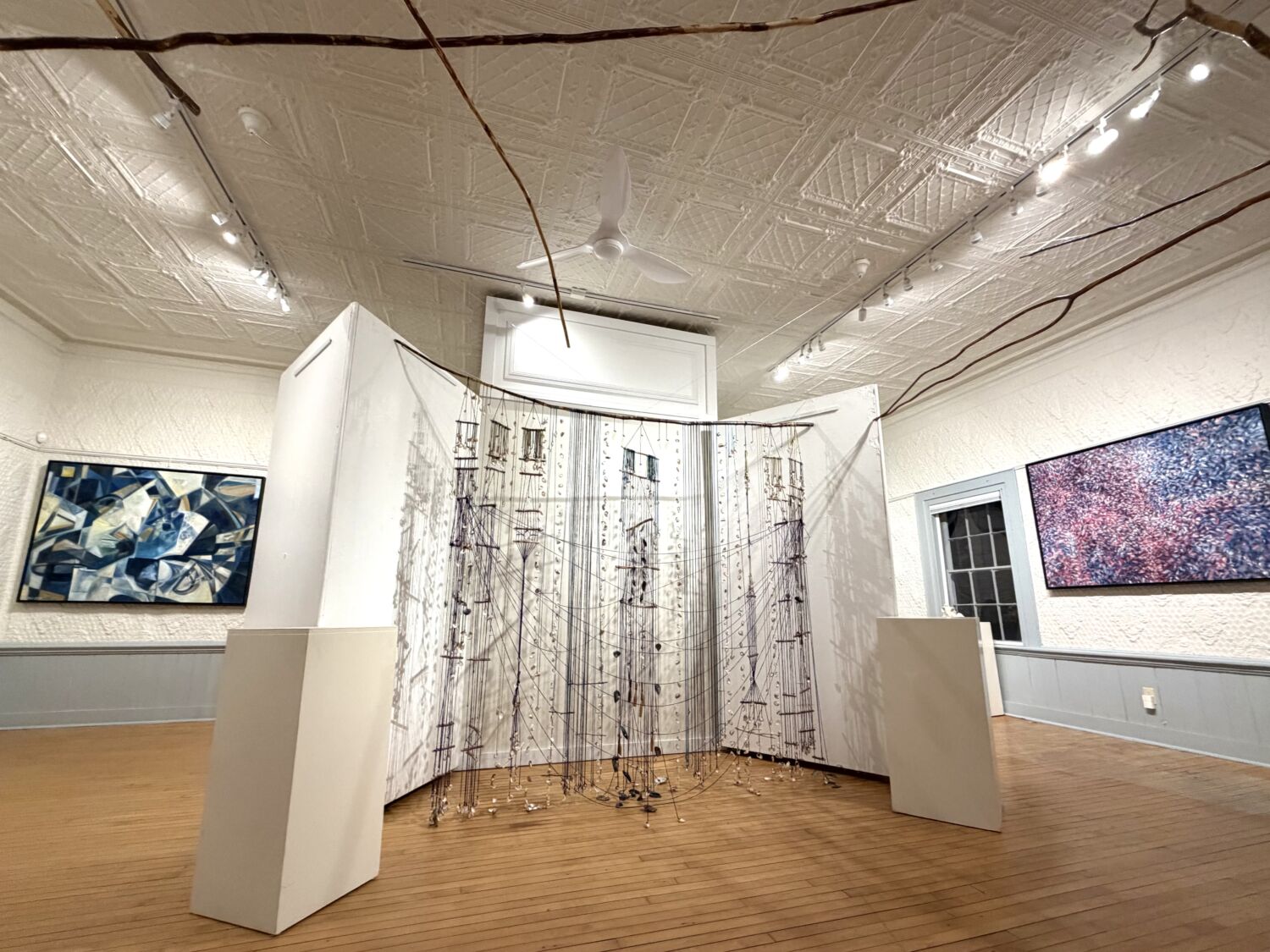
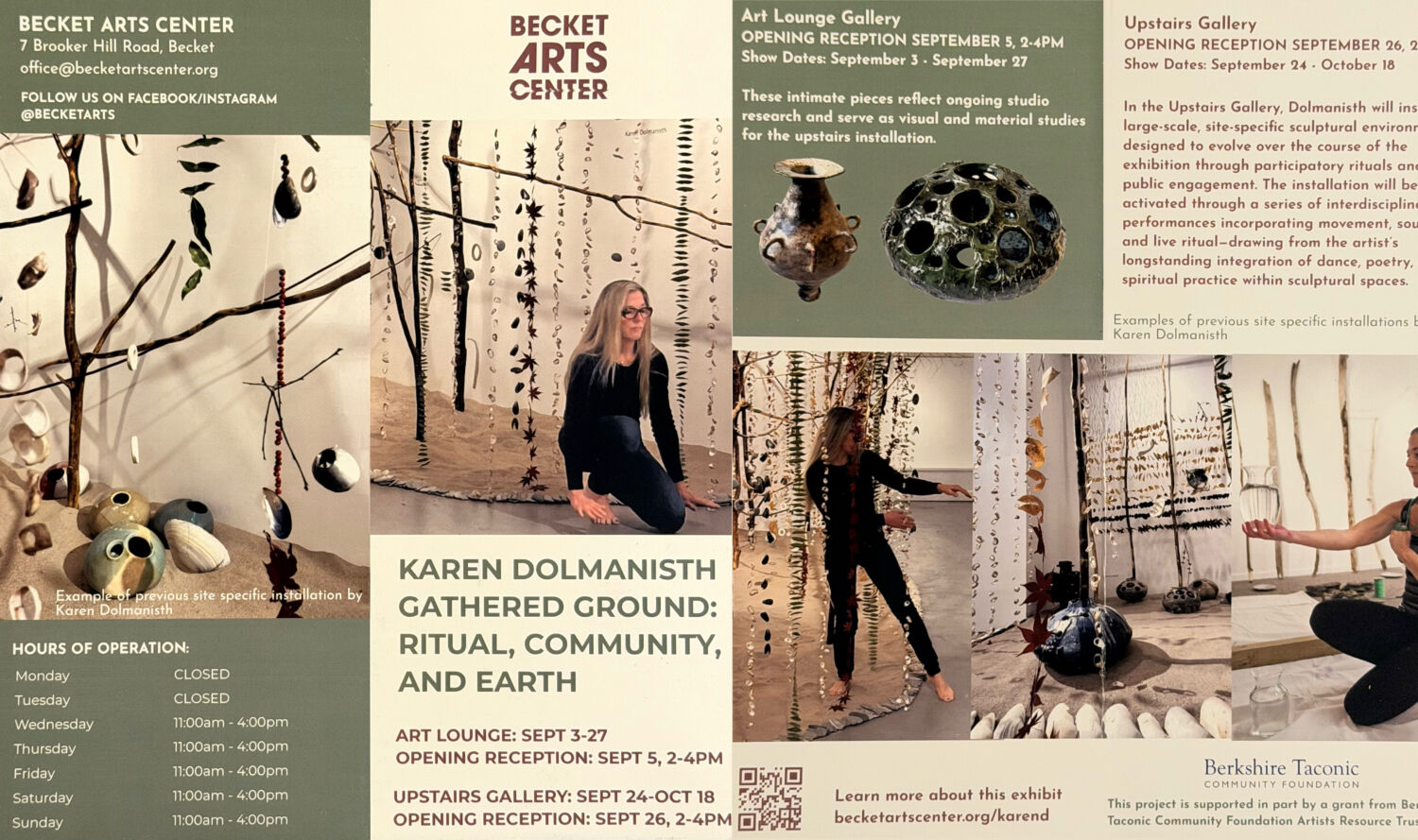
The large site-responsive sculptural environment created for GATHERED GROUND brings these concerns into physical space. Constructed in response to the architecture of the gallery, the installation engages the four directions and four walls, the floor and ground plane, the ceiling and upper reaches of the room, and the open center through which visitors move. Thread, natural materials gathered from the surrounding landscape, fragments retained from earlier works, reused materials, and discarded human-made elements enter into an evolving spatial constellation.
The installation remains deliberately open and responsive. Suspended materials register gravity and subtle currents of air; light continually alters perception; pathways and relationships shift as visitors move through the space. The work is therefore not simply an object to be viewed from a fixed position. It is an environment experienced through the body and through time.
Ritual, within Dolmanisth’s practice, is not the reconstruction of a particular historical or religious ceremony. It is a way of marking significance through attention. Gathering, arranging, repeating, walking, touching, connecting, remembering, and releasing can all become ritual gestures. When music, improvisational dance, or contact improvisation enters the environment, the sculpture becomes further activated as a field of movement, sound, breath, duration, and encounter.
The title GATHERED GROUND refers simultaneously to the physical materials gathered from land and shoreline, the psychological ground of memory and embodied experience, the historical ground of women’s making and cultural knowledge, and the communal ground upon which human beings meet one another.
To gather is to notice what might otherwise be overlooked: a fallen branch, a shell, a fragment, an old thread, a discarded object, a remembered gesture, a story, a form of knowledge carried through generations. Gathering can become an act of care. In this sense, the exhibition proposes making itself as a practice of relationship and attention.
Across Dolmanisth’s work, the boundaries between disciplines, historical periods, materials, and forms of knowledge remain porous. Ancient and contemporary, personal and collective, intellectual and embodied, human and more-than-human, permanence and impermanence are allowed to coexist. Her work does not seek to resolve these relationships into a single narrative. Instead, it creates a space in which they can be sensed.
GATHERED GROUND: RITUAL, COMMUNITY AND EARTH is ultimately an invitation to encounter art as a living practice of connection: between body and earth, past and present, ancestry and possibility, individual and community, material and consciousness. Its threads extend in many directions, holding disparate fragments in relation without erasing their differences.
What has been gathered here is therefore more than material. It is experience, memory, history, scholarship, lineage, place, movement, and attention—brought together temporarily within the shared ground of the exhibition.
The work asks only that we slow down enough to notice the relationships already present: between ourselves and one another, between human hands and the materials they transform, and between all forms of life within the larger web of the living earth.